
The Sovereign Hearth: A Foundational Manual for Restorative Home Architecture
Mission Statement
WithMother LLC: The Architecture of Restoration
A clean, stable home is not a cosmetic luxury—it is a medical necessity and a fundamental human right. Our mission is to restore the sanctity of the private sanctuary through botanical standards, systemic care, and the reclamation of our ancestral legacies.
We serve the postpartum, the post-op, and the elderly, ensuring that every hearth is a foundation for healing, growth, and sovereign dignity. We are not just a service; we are a movement dedicated to the Right to a Restored Hearth.
When we curate a space, we are not merely cleaning; we are providing the environmental stability required for a human being to begin the work of healing. To reclaim our history, we must first reclaim the spaces where that history lives.
Mother Viola Ford Fletcher
A Legacy of Truth and Witness
To understand the necessity of a "Restored Hearth," one must first understand the cost of a hearth destroyed. We honor the life and testimony of Mother Viola Ford Fletcher (May 10, 1914 – November 24, 2025), a foundational witness of the 20th century. As a survivor of the 1921 Tulsa Race Massacre, Mother Fletcher lived through the deliberate, state-sanctioned destruction of the Greenwood District—a thriving hub of Black commerce, homeownership, and communal stability.
At seven years old, Mother Fletcher did not just lose a house; she witnessed the eradication of a sanctuary. Her family’s experience—fleeing with nothing, denied insurance, and forced into decades of economic displacement—is the quintessential story of the "erased hearth."
For over a century, Mother Fletcher carried the memory of Greenwood. In her final decades, she transitioned from a private survivor to a public crusader, testifying before the United States Congress and demanding accountability for the generational wealth that was incinerated in 1921. Her work was not merely about looking backward; it was about ensuring that the mechanisms of erasure could no longer function in the dark.
When we advocate for the "Right to a Restored Hearth," we are fulfilling the promise of Mother Fletcher’s life. We recognize that homeownership, sanitization, and the ability to pass down a clean, stable environment are not just personal tasks—they are acts of resistance. Every time we restore order to a home, we are rebuilding the Greenwood that history tried to burn. We are stewards of a legacy that refuses to be forgotten.
The Witness and the Restoration
The Legacy of Mother Viola Ford Fletcher: Witnessing Erasure, Demanding Restoration
To advocate for the "Right to a Restored Hearth," we must first confront the reality of the hearth destroyed. The life of Mother Viola Ford Fletcher (May 10, 1914 – November 24, 2025) serves as the moral compass for our movement. Mother Fletcher was a survivor of the 1921 Tulsa Race Massacre, a state-sanctioned atrocity that saw the complete incineration of the Greenwood District—an enclave of Black prosperity, homeownership, and independent commerce.
The Historical Facts:
The Destruction of Greenwood: On May 31 and June 1, 1921, white mobs destroyed over 35 square blocks of the Greenwood District. Mother Fletcher, then seven years old, witnessed the arson of her family home. The massacre resulted in the death of an estimated 100 to 300 Black residents and left thousands homeless, effectively erasing the generational wealth and housing security the community had spent decades building.
The Aftermath: The denial of insurance claims and the systemic refusal of the state to acknowledge the crime forced families like the Fletchers into decades of economic displacement. Mother Fletcher’s experience was not an anomaly; it was a deliberate mechanism of exclusion that stripped Black families of the ability to pass down stable "hearths" to their children.
The Testimony: In her later years, Mother Fletcher became a global icon for the reparations movement. In 2021, she testified before the U.S. Congress, stating, "I still see Black men being shot, Black bodies lying in the street. I still smell smoke and see fire. I still see Black businesses being burned." Her testimony forced a reckoning with the history that society tried to bury.
Why This Matters to WithMother LLC: Mother Fletcher’s life is a bridge between the devastation of 1921 and the necessity of truth-telling in 2026. When we restore a home, we are not just cleaning; we are resisting the systemic desire to keep our spaces in disarray, debt, or decay. We recognize that the fight for our homes is the fight for our history. Mother Fletcher did not have the luxury of a "restored hearth" for most of her life; she spent it fighting for the right to one. By documenting her history and centering our business around the sanctity of the sanctuary, we are ensuring that the erasure she witnessed stops with her. We are building the Greenwood of the future—room by room, signature by signature.
The Pre-Massacre Context: The Era of "All-Black Towns" (1914–1920)
The Land of Promise: Mother Fletcher was born in Comanche, Oklahoma. Oklahoma was not unique because it was once "Indian Territory" and later a destination for thousands of Black Americans seeking autonomy in "All-Black Towns" (like Boley or Langston).
The Climate: This was the peak of the Jim Crow era in the South. While Oklahoma offered more independence than the Deep South, it was still subject to strict segregation laws (the "Jim Crow" statutes) that dictated where Black citizens could eat, travel, and reside.
2. The Cataclysm: The Tulsa Race Massacre (1921)
Greenwood's Prosperity: Before the fire, the Greenwood District was known as "Black Wall Street." It was a self-sustaining ecosystem of luxury hotels, doctors' offices, and movie theaters owned by Black entrepreneurs.
The Trigger: On May 31, 1921, a false accusation against a Black man in an elevator triggered an invasion of the district by white mobs.
The Destruction: Over 35 blocks were destroyed. Planes were used to drop turpentine-soaked rags (incendiaries) on roofs, and the National Guard was mobilized—not to protect Greenwood, but to intern its residents. Mother Fletcher’s family lost everything, an experience of total state-sanctioned erasure.
3. The Great Depression and Post-War Industrialization (1930s–1950s)
Survival: Following the massacre, the Fletcher family lived in extreme poverty. The destruction of their wealth during a time of national economic depression (the 1930s) meant that "rebuilding" was stalled for decades.
Industrial Agency: During World War II, Mother Fletcher moved to California to work as a ship welder. This was a critical period where Black women entered high-skill industrial labor, serving as a primary pillar of the "Arsenal of Democracy." This era defined her adult independence, showing how Black workers utilized the industrial boom to reclaim some of the autonomy stolen by Jim Crow.
4. The Civil Rights Movement and the Era of Silence (1960s–1990s)
The "Long Silence": For decades, the history of the Tulsa massacre was suppressed. It was not taught in schools, and local newspapers erased references to it to protect the city's image.
Witnessing the Erasure: During this period, Mother Fletcher lived through the era of "urban renewal," where remaining historic Black districts were often razed for highway construction. She lived as a "silent survivor," holding the truth while the world tried to move on.
5. The Era of Reparation and Recognition (2000–2025)
The Centennial: In 2021, the 100th anniversary of the massacre, Mother Fletcher emerged as the central figure of the movement. She testified before Congress, stating: "I have lived through the massacre every day. Our country may forget this history, but I cannot."
The Legal Fight: Her life bridged the transition from "silent victim" to "legal plaintiff." She became the face of the push for Justice for Greenwood, filing lawsuits seeking reparations for the loss of wealth that prevented her family from inheriting the stability Luther Stuckey fought for in his own community.
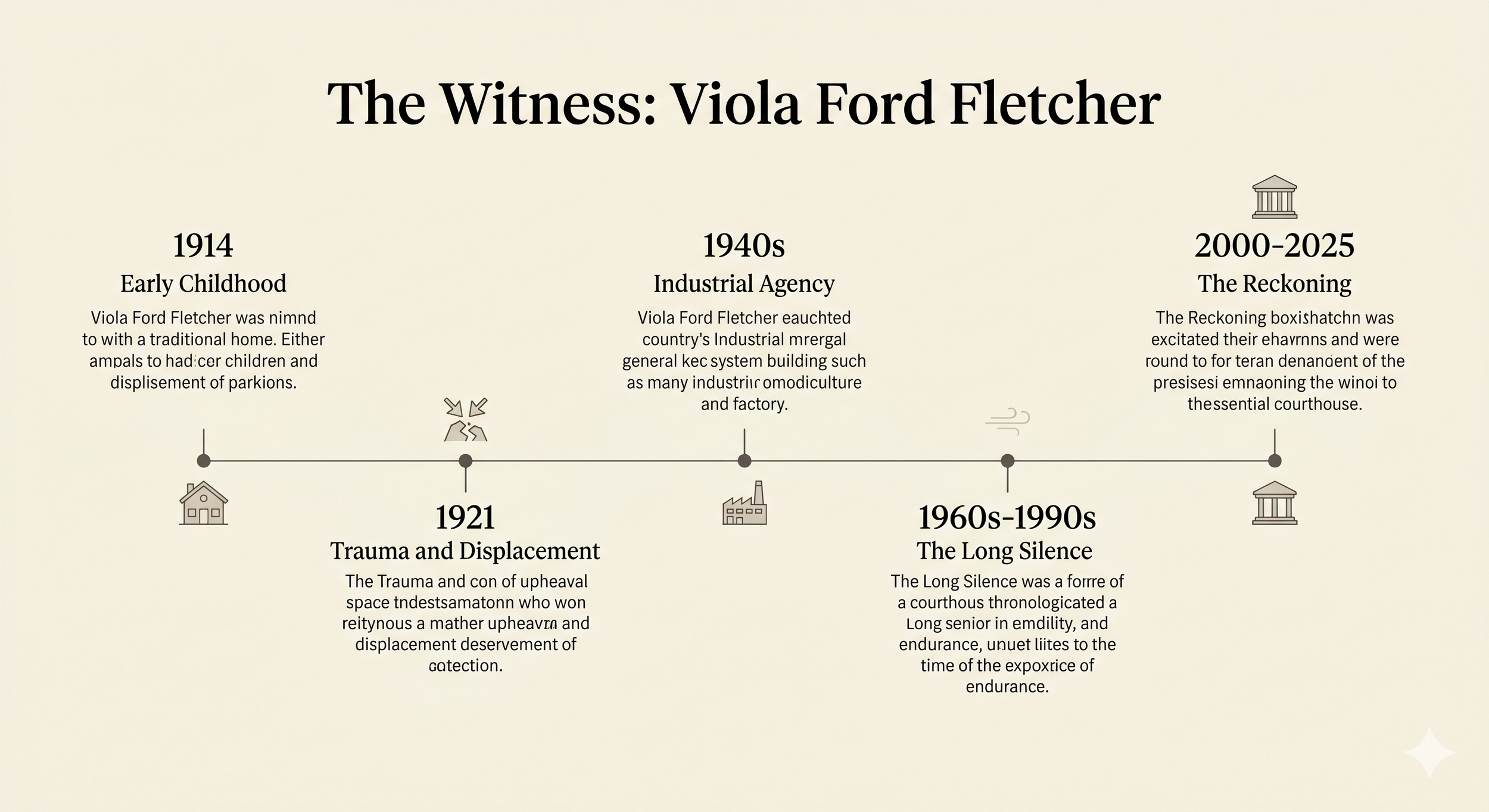
This historical context confirms that Mother Fletcher didn't just "live through" history—she was a primary victim of the most violent era of American property theft, and eventually, one of its most persistent critics.
Luther Harold Stuckey
The Architect of Access: Civil Rights and the Foundation of the Hearth
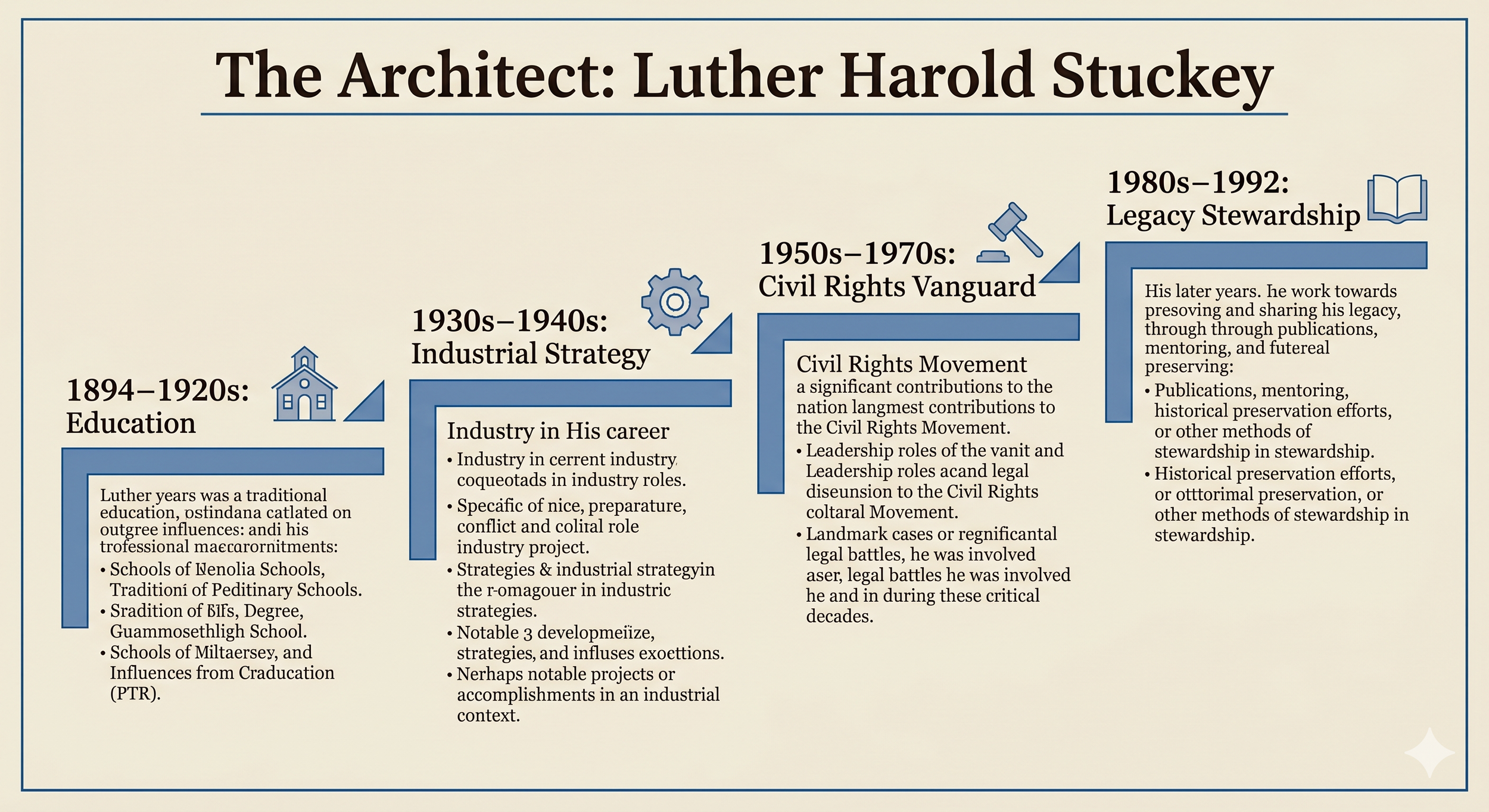
The history of the "Restored Hearth" is incomplete without the legacy of my great-grandfather, Luther Harold Stuckey (1894–1992). A man of profound intellect and iron-willed integrity, Luther Stuckey spent his life dismantling the architecture of segregation in Southern Maryland.
The Historical Facts:
Educational Leadership: Born in Johnsonville, South Carolina, Luther Stuckey attended Allen University before moving to Maryland to serve as an educator. He eventually became the principal of the school in Drayden, Maryland, understanding early on that the foundation of a community’s future is the education of its children.
The Naval Powder Factory Activism: During World War II, Stuckey worked as a pipe fitter at the Naval Powder Factory in Indian Head, Maryland. He did not simply accept the systemic inequality of the facility; he challenged it. He campaigned for decades to end segregation in the employees’ bathrooms and cafeterias, forcing the facility to recognize the dignity of its Black workforce.
NAACP Presidency: For over 24 years, Stuckey served as the President of the Charles County chapter of the NAACP. During his tenure, he was a pivotal force in the fight for equal pay for Black teachers and ensured that non-white students were granted the right to ride school buses (a core component of the landmark Hart Case).
Dismantling Route 301: Perhaps most famously, Stuckey enlisted the help of "Freedom Riders" to confront the "Whites Only" signage at motels and restaurants along Route 301 in Charles County. His work was relentless, methodical, and profoundly dangerous. He moved systematically to replace exclusion with access.
Why This Matters to WithMother LLC: Luther Stuckey fought to open the doors of public spaces so that Black families could exist in the world with dignity. My work with WithMother LLC is the continuation of that fight, moving from the public square into the private sanctuary. If my great-grandfather spent his life fighting for the right to be served, I am spending my life fighting for the right to be nurtured within our own homes.
We are not merely a business; we are an institution built on the refusal to accept "second-class" conditions for our hearths. When we restore a home to a state of botanical, systemic, and organizational health, we are building upon the foundation that Luther Stuckey laid: a foundation of self-respect, community agency, and the unwavering belief that our families deserve to occupy space—public or private—with absolute sovereignty.
The Strategy of Soil
Land as Resistance: The Legacy of Stuckey Road
History is often told through the stories of the displaced, but there is a parallel history written by those who refused to be moved. The establishment of "Stuckey Road" in Charles County, Maryland, is not just a geographical location—it is a documented act of economic and social resistance.
The Historical Facts:
Kinship Enclaves: In the post-Reconstruction South and Mid-Atlantic, Black land ownership was the primary barrier against the volatility of tenant farming and urban displacement. By purchasing land and subdividing it for his sons, Luther Stuckey created a "kinship enclave." This was a deliberate strategy to ensure that family members lived in proximity, creating a private social safety net that did not rely on—or require—the approval of local white power structures.
The Economics of Autonomy: For a Black pipe fitter at the Naval Powder Factory, land was the ultimate form of capital. It was a tangible asset that could be improved, passed down, and used as collateral. While redlining and systemic lending discrimination (such as the FHA’s exclusionary practices of the 1930s-50s) made it nearly impossible for many families to secure standard bank loans, families like the Stuckeys used direct land acquisition to bypass the predatory real estate market.
Resisting Erasure: The renaming or informal naming of rural roads after Black families was a common way of asserting presence on the landscape. By identifying as "Stuckey Road," the community declared that this soil was not just "owned," but inhabited by a lineage.
Why This Matters to WithMother LLC: We are often told that we are "transient" by nature, that we lack roots, or that we are newcomers to the American story. The history of Stuckey Road proves the opposite. We are stewards by design. My great-grandfather did not just build houses; he built fortresses against the systemic attempt to displace Black families. When we speak of a "Restored Hearth," we are echoing the same philosophy: the home is the foundation of our sovereignty. If you control your four walls and the soil beneath them, you control your destiny.
1. The Early Years and Educational Foundations (1894–1920s)
The Southern Landscape: Born in Johnsonville, South Carolina, in 1894, Luther Stuckey grew up in the Jim Crow South. This era was defined by the entrenchment of "separate but equal" doctrine following Plessy v. Ferguson (1896).
The Role of HBCUs: He attended Allen University in Columbia, South Carolina. Historically Black Colleges and Universities (HBCUs) of that era were the primary incubators for the intellectual resistance that would eventually drive the Civil Rights Movement. Education was not just personal advancement; it was a form of communal survival.
The Great Migration (The Educational Diaspora): In the early 20th century, many Black educators from the Deep South moved to the Mid-Atlantic and North to teach in segregated schools. His transition to Maryland was part of this "Educational Diaspora"—moving to areas with different segregation dynamics to secure employment while continuing the work of community building.
2. World War II and the "Arsenal of Democracy" (1940s)
The Shift to Industrial Labor: When World War II broke out in 1941, the United States became the "Arsenal of Democracy." However, defense jobs were strictly segregated.
The Naval Powder Factory (Indian Head, Maryland): By taking a position as a pipe fitter at the Naval Powder Factory, Stuckey moved from the classroom to the industrial front lines. This was a strategic shift. Industrial centers were federal facilities, and therefore theoretically subject to federal executive orders (like FDR’s Executive Order 8802), which forbade discrimination in defense industries. Stuckey was a master of using federal policy to challenge local bigotry.
3. The Civil Rights Era and the NAACP (1950s–1970s)
The NAACP as a Legal Machine: Under his 24-year leadership of the Charles County NAACP, the organization functioned less like a social club and more like a legal firm. This was the era of Brown v. Board of Education (1954). Stuckey’s work in Charles County to integrate school buses (the "Hart Case") occurred at a time when school boards were using "administrative foot-dragging" to ignore federal integration mandates.
Route 301 and the "Public Accommodations" Fight: Route 301 was a major artery for travelers. The "Whites Only" signage wasn't just a sign; it was a barrier to the basic human right of travel. By enlisting the Freedom Riders—national figures who focused on the interstate nature of travel—he effectively forced the local government to choose between federal compliance or public embarrassment.
4. The Legacy of the 1990s and the End of an Era
The Passing of the Vanguard: Luther Harold Stuckey died in 1992 at age 98. His death marked the end of the "Founding Vanguard"—the generation that had witnessed the transition from the plantation-adjacent life of the 1890s to the integrated, albeit still segregated, reality of the 1990s.
Oral History as Preservation: His 1976 oral history interview (housed at the Maryland Center for History and Culture) is a critical historical artifact. It captures the "how" of civil rights activism—the day-to-day meetings, the threats, and the meticulous process of filing grievances.
The Botanical Standard
Restorative Science: Reclaiming the Chemistry of the Hearth
The "Restored Hearth" is not maintained by the harsh, synthetic chemicals sold in common aisles. Those cleaners rely on VOCs (Volatile Organic Compounds) that linger in stagnant air, triggering respiratory and endocrine distress. To build a sovereign home, we must transition to a Botanical Standard—the use of plant-based surfactants that clean at a molecular level without sacrificing the biological health of the inhabitant.
The Science of Botanical Sanitization:
Synthetic cleaners often work by stripping surfaces, leaving behind residues that disrupt the home's microbiome. My protocols utilize plant-derived surfactants that interact with grime through natural polarity: the hydrophobic tail binds to grease and oil, while the hydrophilic head allows the entire bond to be lifted away by water. It is a clean, chemical-free process that honors the integrity of the surface and the occupant.
The Protocol for the Restored Hearth:
The Purge: Systematically audit your storage areas and remove any product containing synthetic fragrances, phthalates, or ammonia. These are not "cleaners"; they are environmental stressors.
The Re-Alignment: Replace these with our botanical formulations. These solutions are calibrated to sanitize environments at a medical standard—an essential requirement for post-op recovery, postpartum mothers, and the elderly.
The Maintenance of Sanctuary: Treat the sanitization of your home as a medical duty. A clean home is the frontline of a clear mind. By removing the toxicity from your surfaces, you provide your nervous system the stability it needs to transition from "survival mode" to "restorative mode."
Fact: Research published in the American Journal of Respiratory and Critical Care Medicine indicates that regular use of common household cleaning sprays can cause long-term respiratory damage equivalent to smoking a pack of cigarettes a day. Choosing botanical standards is not a luxury choice; it is an act of environmental self-defense.
Restorative Science: Reclaiming the Chemistry of the Hearth
The "Restored Hearth" is not maintained by the harsh, synthetic chemicals found in standard retail aisles. These cleaners rely on volatile organic compounds (VOCs) that linger in stagnant air, triggering respiratory and endocrine distress. To build a sovereign home, we must transition to a Botanical Standard—the use of plant-based surfactants that clean at a molecular level without sacrificing the biological health of the inhabitant.
The Scientific Case for Botanical Transition:
The Microbiome Disruption: Research published in Nature (2018) on the "Infant Microbiome" demonstrates that high-frequency use of disinfectant sprays in the home environment is directly linked to altered gut bacteria and an increased risk of childhood asthma. When we "sanitize" with harsh chemicals, we do not just remove pathogens; we destroy the beneficial microorganisms that help regulate our immunity.
The Endocrine Threat: Many common cleaners contain phthalates (used as synthetic fragrances) and alkylphenol ethoxylates. According to the Endocrine Society, these chemicals are "endocrine disruptors" that mimic human hormones, potentially interfering with reproductive health and developmental growth.
The Molecular Mechanics of Surfactants:
My protocols utilize plant-derived surfactants that interact with grime through natural polarity: the hydrophobic (water-fearing) tail binds to grease and oil, while the hydrophilic (water-loving) head allows the entire bond to be lifted away by water. It is a clean, chemical-free process that honors the integrity of the surface and the occupant.
The Protocol for the Restored Hearth:
The Purge: Systematically audit your storage areas and remove any product containing synthetic fragrances, phthalates, or ammonia. These are not "cleaners"; they are environmental stressors.
The Re-Alignment: Replace these with botanical formulations. These solutions are calibrated to sanitize environments at a medical standard—essential for postpartum mothers, the elderly, and post-op recovery.
The Maintenance of Sanctuary: Treat home sanitization as a medical duty. A clean home is the frontline of a clear mind. By removing toxicity from your surfaces, you provide your nervous system the stability it needs to transition from "survival mode" to "restorative mode."
Fact: A landmark study from the University of Bergen (Norway) published in the American Journal of Respiratory and Critical Care Medicine tracked over 6,000 participants for 20 years. The findings were stark: women who performed cleaning regularly—or worked as professional cleaners—experienced a decline in lung function equivalent to smoking 20 cigarettes a day for up to two decades. Botanical standards are not a luxury; they are an act of environmental self-defense.
The Architecture of Lineage Reclamation
The Truth of Our Soil: Connecting the Ancestral Root to the Sovereign Hearth
Genealogical research is not merely a hobby; it is a critical act of data verification. Many families, once told their roots were exclusively "foreign" or obscured by the trauma of forced migration, discover through rigorous archival work that their ancestors were born and rooted within the American landscape for centuries. Reclaiming this lineage is the primary step in asserting our sovereign right to land, home, and historical truth.
The Fact-Based Path to Reclamation:
Verification vs. Myth: Oral traditions often hold the emotional truth of our history, but archival verification—census records, land deeds, and birth registries—provides the legal bedrock for reclamation. When we reconcile these two, we move from "stories" to "documented rights."
Archival Preservation: The work of the XyayX Institute and similar archives is vital because they actively protect narratives that state-run institutions have spent a century attempting to erase. They treat our history as a living entity, not a dead record.
The Intergenerational Connection: This is not just about the past; it is about the continuity of the hearth. When we verify our lineage, we are mapping the territory that was meant to be our sanctuary.
Why This Supports Our Movement:
We are partnering with the entities doing the heavy lifting of historical restoration.
The XyayX Institute: We direct our support here because they understand that without a verified history, we cannot effectively advocate for the reparations or the policy shifts required to guarantee the "Right to a Restored Hearth."
Our Mommy Village & Mama Primitiva: We integrate our botanical and organizational protocols with these networks because "restoration" cannot happen in isolation. It requires a village to maintain a sanctuary.
Fact: A study by the National Genealogical Society found that archival research into family history significantly improves individual psychological well-being by providing a sense of "historical continuity" amidst contemporary instability. Reclaiming who we are is, quite literally, part of the restorative work we perform within the home.
The Architecture of Lineage Reclamation
The Truth of Our Soil: Connecting the Ancestral Root to the Sovereign Hearth
Genealogical research is not merely a hobby; it is a critical act of data verification. Many families, once told their roots were exclusively "foreign" or obscured by the trauma of forced migration, discover through rigorous archival work that their ancestors were born and rooted within the American landscape for centuries. Reclaiming this lineage is the primary step in asserting our sovereign right to land, home, and historical truth.
The Fact-Based Path to Reclamation:
The Educational Disadvantage: Historically, the American educational system has functioned as an engine of erasure. For generations, the curriculum was designed to misrepresent the history of Black land ownership and lineage.
Fact: In the early 20th century, "segregated but equal" schooling meant that textbooks in Black schools were often discarded, outdated, and intentionally devoid of Black history, forcing students to learn from a narrative that framed their ancestors as "transients" or "foreigners" rather than foundational citizens.
The Misrepresentation: The systematic omission of Black agricultural and economic contributions—such as the success of All-Black towns or the independent kinship-building in places like Charles County—served to alienate Black students from their own heritage, creating a "psychological homelessness" that made land reclamation appear impossible.
Black Maternal Health and The Restorative Necessity:
The Maternal Crisis: According to data from the CDC and the National Institute of Minority Health and Health Disparities, Black women are three times more likely to die from pregnancy-related complications than white women. This disparity persists regardless of education or income level, pointing to "weathering"—the cumulative impact of systemic stress on the body.
The Link to the Hearth: The environment in which a mother recovers is a critical determinant of health. When a home is unstable or toxic, the physiological stress response (cortisol elevation) exacerbates the maternal health crisis. Restorative home care—sanitizing the environment, organizing the space, and removing environmental stressors—is not just about cleanliness; it is a targeted intervention against the physiological "weathering" that threatens Black maternal survival.
Why This Supports Our Movement:
We are partnering with the entities doing the heavy lifting of historical and biological restoration.
The XyayX Institute: We direct our support here because they understand that without a verified history, we cannot effectively advocate for the reparations or policy shifts required to guarantee the "Right to a Restored Hearth."
Our Mommy Village & Mama Primitiva: We integrate our protocols with these networks because "restoration" cannot happen in isolation. It requires a village to maintain a sanctuary against systemic stressors.
The Village Call
The Signature Challenge: Reclaiming the Right to a Restored Hearth
This movement is not built on passive agreement; it is built on collective action. We are launching the 100,000 Signature Challenge to demand a shift in how our society values home care. We are calling for 100,000 voices to stand with us in declaring that restorative home care is not a luxury—it is a medical necessity.
Our Objective:
We are lobbying for policy changes that recognize restorative home maintenance as a covered service under medical insurance for the postpartum, the elderly, and the post-op. By framing the "Restored Hearth" as a public health intervention, we bridge the gap between individual well-being and systemic support.
Collective Generosity: The Village Fund
We are harvesting the "gold" from our unscripted lives to build a foundation of radical support. By purchasing this guide, you are directly funding the entities doing the work of historical and social restoration:
15% of all proceeds from this product are split between the XyayX Institute, Our Mommy Village, and Mama Primitiva.
These organizations are the stewards of our history and the protectors of our current mother-led communities. Supporting them is not a donation; it is an investment in our sovereign future.
Join the Movement:
Sign the Petition: Visit https://www.wmotherllc.com/the-sanctuary to join the 100,000 Signature Challenge.
Share Your Story: Record a video of what the "Sovereign Hearth" means to your lineage and tag us.
The Village Commitment: Carry the botanical and systemic protocols provided in this guide into your own home. Every room you restore is a room reclaimed.
The hearth is restored. The village is waiting. Clean Homes. Clear Minds. Our history is our future.
